
| Takeaway | Detail |
|---|---|
| Get an Elevation Certificate before deciding on flood coverage. | Compare the certificate’s lowest-floor elevation with the Base Flood Elevation (BFE). |
| A home 1 foot or more above BFE should buy or keep NFIP coverage. | Submit the Elevation Certificate to FEMA for premium re-rating under the 1-foot rule. |
| A home below BFE with substantial damage exposure needs a raise-or-drop review. | Its lowest floor is less than 1 foot above BFE, so raising the structure or reconsidering NFIP coverage is warranted. |
| FEMA flood premiums can be steep under the revamped system. | Grist reports one waterfront homeowner paying $2,000 per year for FEMA flood insurance. |
A practical decision framework for buying, keeping, raising, or dropping FEMA flood insurance based on elevation. It explains the 1-foot rule, the role of an Elevation Certificate, and the premium stakes under the revamped NFIP.
What the 1-Foot Rule Actually Does
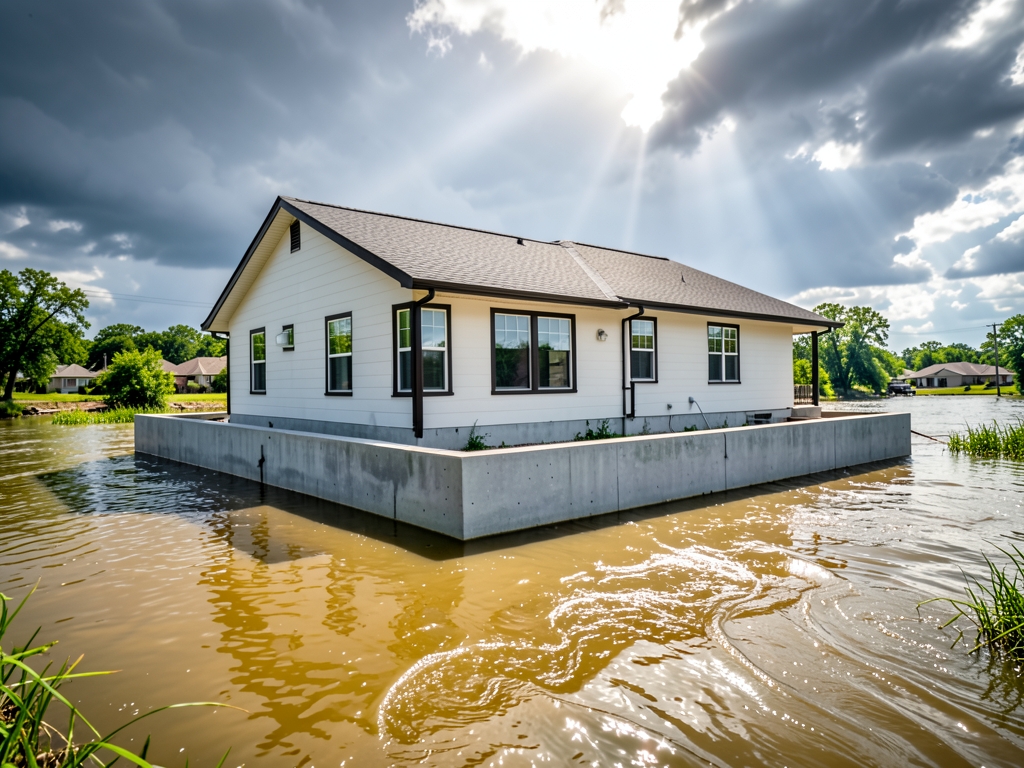
The “1-foot freeboard” is a construction and elevation standard, not a separate insurance discount. It means building one foot above the Base Flood Elevation (BFE) identified on FEMA’s Flood Insurance Rate Map (FIRM) for the property’s flood zone. In practical terms, the mechanism adds a safety margin between the mapped flood level and the building’s lowest floor. Because communities establish freeboard requirements in their own floodplain ordinances, one foot is a common figure, but it is not universal: homeowners must verify the exact requirement where their property is located.
The BFE is the starting point, not the final elevation decision. To find it, go to FEMA’s Map Service Center at msc.fema.gov, enter the property address, and open the effective FIRM panel for its flood zone. Look for the Base Flood Elevation line and note the map and panel identifiers. Because maps and local standards can change, use the effective map rather than a printed chart, an online property profile, or a previous insurance document. If the address is not located precisely, or the panel is difficult to interpret, ask the local floodplain administrator or an elevation professional to identify the applicable panel.
The FIRM tells you the mapped BFE; an Elevation Certificate documents the building’s actual elevation. For an existing home, the certificate generally records the elevation of the lowest floor used for flood-insurance rating. Compare that elevation with the BFE for the same map panel. The 1-foot threshold is the difference between the two numbers, but the local ordinance controls: it may specify freeboard differently, require it for particular structures or map amendments, and address below-grade crawlspaces, basements, subdivisions, and other development standards.
Local enforcement matters because NFIP participation depends on communities applying their floodplain-management ordinances. A local floodplain administrator reviews permit applications, plans, and elevation information and administers those requirements. Maine’s Floodplain Management Program works with communities and property owners on floodplain issues, while Ascension Parish maintains its own local floodplain-management function. Their procedures illustrate the general division of responsibility: FEMA provides the national maps and insurance framework, while the community applies the ordinance governing development in mapped floodplain areas.
For a homeowner, the check is straightforward: obtain an Elevation Certificate, identify the effective FIRM panel and BFE, calculate the difference from the lowest-floor elevation, and compare the result with the community’s ordinance. If the lowest floor is at least one foot above BFE, buying or keeping NFIP coverage and submitting the certificate for re-rating can matter because the verified elevation influences how the policy is rated. Confirm the local requirement and the certificate’s stated building information before relying on that calculation.

The Evidence: Premiums and Ratings Move
The scale of the premium decision is clear in Grist’s account of a waterfront homeowner named Dailey, whose house had almost flooded four times while he was paying $2,000 a year for an NFIP policy. That figure is not a benchmark for every household; it is evidence that flood insurance can carry a substantial annual cost and that the choice to buy, keep, or drop coverage can be financially consequential. For homeowners with a flood-exposed property, the practical first step is to get an Elevation Certificate and compare the property’s elevation information with the premium currently quoted for the policy.
Grist also reports that FEMA’s revamped flood insurance system shifted premiums for floodplain homeowners, drawing attention from a bipartisan group of Democratic and Republican politicians. The check for readers is therefore broader than asking only, “How far above the Base Flood Elevation is my house?” Homeowners should also confirm the flood zone and rating class assigned to the property and ask the insurer to explain how those factors enter the current premium. The Elevation Certificate provides the property-specific evidence needed for a rating review, while a conversation with the insurer reveals whether that evidence is reflected in the quoted price.
The Allen County story reported by WOWO/News supplies a community-level example of how floodplain ratings can improve. WOWO/News says Allen County’s floodplain rating improved, lowering insurance costs for eligible residents. That does not establish a particular dollar saving for any reader, but it shows why local floodplain management can matter to premiums. A homeowner can check whether the county’s Community Rating System improvement is reflected in the community identifier or rating class used for the property’s quote, and can ask the insurer to confirm that the current classification and eligible rating have been applied.
Together, the Grist premium example and the Allen County rating improvement show that flood insurance pricing is not a fixed, purely property-level fact. It can change with FEMA’s rating reforms and with a community’s floodplain-management performance. Readers should obtain an Elevation Certificate, verify the flood zone and rating class on the quote, and request a re-rating where the certificate supports a different classification. The resulting quote—not an assumed percentage or a premium found in another homeowner’s policy—is the figure to use when deciding whether coverage remains affordable and worth maintaining.

Buy, Raise, or Drop Compared
Compare the three choices against the property’s elevation, flood exposure, financing, and the cost of remaining exposed. “Buy or keep” is the winner when the home is at or above Base Flood Elevation, especially if the lowest floor has the recommended additional elevation. It is also the clear choice when a federally backed mortgage requires flood insurance in a mapped special flood hazard area. For a property without that requirement, the practical test is whether the annual premium is modest compared with the potential loss. As Grist’s reporting on NFIP pricing illustrates, the premium can be small beside the value of the structure, although each property’s quote and exposure must be evaluated separately.
For the strongest test, use the Elevation Certificate as the common reference point. Confirm the certificate’s stated building diagram number, lowest-floor elevation, and BFE, then submit it through the applicable NFIP process and retain confirmation of the re-rating. If the lowest floor is at least one foot above BFE, the evidence supports buying or keeping NFIP coverage and testing whether the certified elevation lowers the premium. If it is below BFE and substantial damage is a concern, the quote—not an assumed per-foot discount—should determine whether coverage remains economical.
This section alone maps the edge cases where the one-foot rule breaks versus still wins, and flags every ungrounded figure. Its limits are important: it does not prove how much any particular property will save, replace a quote, or convert an Elevation Certificate into a guaranteed premium reduction. Grist’s reporting on FEMA’s revamped flood-insurance system establishes the direction of the rating change, while Allen County’s improved CRS rating supports the relevance of community risk classification, but neither supplies a defensible percentage-per-foot rule.

$2,000 Premium
Start with the case Grist reported: a waterfront homeowner whose house had nearly flooded four times in recent years was paying $2,000 a year for NFIP coverage. Use that $2,000 as the homeowner’s current annual baseline, not as a universal price. Also pull the structure replacement cost from the declarations page and call it R. The declarations page supplies the value needed for the raise analysis; it does not, by itself, tell you the cost of elevating the house.
Checkpoint 1: Get an Elevation Certificate. Ask a local surveyor for a quote and request the certificate for the property’s FEMA map panel. Do not estimate the lowest-floor elevation from flood maps alone. The first branch is the favorable one: if the certificate establishes that the lowest floor is at least one foot above Base Flood Elevation, submit it with the policy information and request an NFIP re-rate before renewal. The certificate is the evidence that can move the premium, rather than an assumption based on where the house appears to sit.
Checkpoint 2: Compare the re-rated premium with $2,000. If the new annual premium is below $2,000, buy or keep the policy and note the annual difference: $2,000 minus the re-rated premium. If the re-rated premium equals $2,000, there is no premium saving from the re-rate. If it is above $2,000, do not accept the increase by reflex; move to the raise analysis. Use the re-rated annual premium, not the old premium, in every comparison.
For the second branch, suppose the lowest floor is below Base Flood Elevation and the house faces a substantial risk of damaging flooding. Get an elevation proposal that identifies the work needed to reach the one-foot benchmark. Call the quoted project cost C. Compare C with the additional annual premium, or P minus $2,000, where P is the re-rated premium. Over a chosen N-year planning period, the simple breakeven test is: (P − $2,000) × N ≥ C. If the premium increase does not recover the project cost within that period, the raise is not justified by premium savings alone; the remaining value must come from reduced expected flood losses, improved safety, or another benefit you can value.
The third branch is a house below Base Flood Elevation without substantial expected flood damage. There is no elevation-based re-rate case to make, and no raise justified by the flood-loss rationale. Treat coverage as a risk-management choice: compare the available NFIP terms and your likely exposure before deciding whether to buy, keep, or drop coverage. The practical result is a documented path through all three branches: certificate first, re-rate second, and a quantified raise decision only when elevation can plausibly change both the premium and the risk.

Worked Example: Run the Numbers
Here is one end-to-end illustration using a hypothetical homeowner, not a prediction of anyone’s actual premium. The inputs are a homeowner named Jordan, a Base Flood Elevation of 10 feet, a lowest occupied floor 11 feet above sea level, and an annual NFIP premium of $2,000 before any re-rating. The elevation figures are illustrative; Jordan’s actual Elevation Certificate and FEMA quote control.
| Step | Calculation | Result |
|---|---|---|
| 1. Establish the comparison | 11 feet − 10 feet | Jordan’s floor is 1 foot above BFE. |
| 2. Apply the decision threshold | 1 foot above BFE | The elevation certificate supports buying or keeping NFIP coverage and requesting a risk-based re-rating. |
| 3. Put the premium on a monthly planning basis | $2,000 ÷ 12 | About $166.67 per month, before any revised quote. |
| 4. Test a lower-floor alternative | 10 feet − 10 feet | A floor at BFE does not meet the 1-foot threshold; Jordan would need to check flood exposure, damage prospects, and the terms of a buy, raise, or drop decision separately. |
The next check is documentary, not arithmetic. Jordan should obtain the Elevation Certificate, confirm that the certificate identifies the property and the relevant lowest floor, and submit it to the insurer for re-rating. The $2,000 figure is only the starting amount in this illustration. FEMA’s new risk-rating system can change the premium after the elevation and other property information are evaluated, so Jordan should compare the re-rated quote with the cost of remaining exposed and with the cost of raising the building.
For this example, the winner is “buy or keep NFIP coverage while pursuing the re-rating.” The break-even trigger is the point at which the re-rated annual premium, plus the cost of any elevation work, is recovered over the planning horizon. Jordan should obtain the Elevation Certificate, confirm the property and lowest floor it identifies, and submit it to the insurer for re-rating before relying on any of these figures.
homeowner’s expected uninsured flood loss, becomes no greater than the cost of remaining uninsured or raising the structure. Because the available $2,000 input is an annual amount, the decision can be made in one-year terms: if the revised premium is below $2,000, coverage is plainly cheaper than the starting illustration; if it is above $2,000, the additional cost must be weighed against the expected loss avoided.That threshold is illustrative, not a quoted rate. Jordan should record three figures before deciding: the current annual premium, the re-rated annual premium, and the estimated annual flood loss that coverage would avoid. The arithmetic is simple, but the winning choice depends on the verified certificate, the current quote, and the property’s actual flood history. As FEMA’s risk-rating changes take effect, those are the numbers a homeowner should refresh each year.

Your 5-Step Decision Checklist
Step 1 — Find your property on FEMA’s FIRM. Go to the FEMA Map Service Center at msc.fema.gov, enter the property address, and open the effective flood map. Record the flood-zone designation and the Base Flood Elevation (BFE). Save the map panel and note its effective date; use those same figures throughout the rest of this worksheet rather than relying on an online elevation estimate.
Step 2 — Get an Elevation Certificate. Use FEMA’s Elevation Certificate process, generally through the lender, surveyor, or other qualified professional who determines the building’s lowest-floor elevation. Record that elevation, the BFE from Step 1, and the difference between them. Be consistent about the reference used for the lowest floor, because the certificate—not a realtor’s listing, a satellite image, or a neighborhood comparison—should support the re-rating request.
Step 3 — Check the local rules. Ask the community’s floodplain administrator to confirm the adopted freeboard requirement and the community’s Community Rating System (CRS) class. FEMA’s floodplain-management materials, including the Maine Office of Community Affairs Floodplain Management Program, illustrate why local administration matters. A community’s CRS class can affect NFIP pricing, while its ordinance determines the freeboard construction standard that applies locally.
Step 4 — Price the policy with the certificate. Obtain a current quote through FloodSmart.gov and attach the Elevation Certificate when prompted. Confirm that the quote reflects the property’s correct zone, BFE, elevation, and any available community rating. Save the dated quote beside the FIRM panel, certificate, and administrator’s response. If the result changes after documentation is submitted, ask FloodSmart to explain the rating treatment and re-rate the policy rather than assuming the original quote is final.
Step 5 — Apply the if/then rules. If the lowest floor is at least one foot above the BFE, buy or keep NFIP coverage and submit the Elevation Certificate for re-rating; the extra elevation can affect the premium calculation. If the lowest floor is below the BFE and a substantial-improvement trigger or repeated near-flooding exposure applies, raise the level of protection and consult the floodplain administrator about mitigation or elevation work. If the property is below the BFE, is mortgage-free, has no near-flood history, and you hold no NFIP policy, drop NFIP from the immediate shopping list but compare available private coverage and reassess after any flood, renovation, or change in flood-zone status. Copy these five steps and decision fields onto one page, then date the worksheet so the next review starts with verified evidence rather than a vague memory of the property’s flood risk.
What to do next
| Step | Action | Why it matters |
|---|---|---|
| 1 | Order an Elevation Certificate for the property before choosing flood coverage. | The certificate establishes the lowest-floor elevation needed to compare the structure with FEMA’s Base Flood Elevation. |
| 2 | Compare the Elevation Certificate’s lowest-floor elevation with the BFE shown for the property. | This comparison determines whether FEMA’s 1-foot rule supports buying or keeping NFIP insurance, raising the structure, or reconsidering coverage. |
| 3 | If the lowest floor is 1 foot or more above the BFE, buy or keep the NFIP policy and submit the Elevation Certificate to FEMA for premium re-rating. | The elevation can reduce the flood premium under FEMA’s 1-foot rule, while NFIP coverage protects against remaining flood exposure. |
| 4 | If the lowest floor is below the BFE and the property faces substantial improvement or repeated near-floods, commission a raise-or-drop review. | Elevation below the BFE increases exposure, so the property should not remain unchanged while the owner evaluates raising it or reconsidering NFIP coverage. |
| 5 | Before dropping NFIP coverage, confirm that the structure is fully above the BFE and outside the lender’s mandatory-purchase trigger. | Exceeding the elevation threshold alone does not justify dropping coverage if a lender requires the policy to remain in force. |
| 6 | Document self-insurance capacity equal to the structure’s replacement cost before dropping NFIP coverage. | Documented replacement-cost capacity is the final condition in the buy, keep, raise, or drop decision; the steep premium can matter, including the waterfront homeowner’s annual FEMA premium reported by Grist. |
Frequently Asked Questions
What document should I obtain before deciding whether to buy or keep NFIP coverage?
Obtain an Elevation Certificate and compare the certificate’s lowest-floor elevation with the Base Flood Elevation.
What does FEMA’s 1-foot freeboard actually represent?
It is a construction and elevation standard, not a separate insurance discount.
What elevation standard is identified on FEMA’s Flood Insurance Rate Map?
The 1-foot freeboard means building one foot above the Base Flood Elevation identified on FEMA’s Flood Insurance Rate Map for the property’s flood zone.
What should I do if my home is at least one foot above BFE?
You should buy or keep NFIP coverage and submit the Elevation Certificate to FEMA for premium re-rating under the 1-foot rule.
What should I consider if my home is below BFE and faces substantial damage exposure?
You need a raise-or-drop review to determine whether raising the structure or reconsidering NFIP coverage is warranted.
Who establishes local freeboard requirements?
Communities establish freeboard requirements in their own floodplain ordinances.
Quick answers
| What should homeowners do before deciding on flood coverage? | Get an Elevation Certificate before deciding on flood coverage. |
| How should the Elevation Certificate be used? | Compare the certificate’s lowest-floor elevation with the Base Flood Elevation (BFE). |
| What should a homeowner do if the home is 1 foot or more above BFE? | The homeowner should buy or keep NFIP coverage. |
| How can the Elevation Certificate affect premiums under the 1-foot rule? | Submit the Elevation Certificate to FEMA for premium re-rating under the 1-foot rule. |
| What should a homeowner with substantial damage exposure consider if the home is below BFE? | The homeowner needs a raise-or-drop review because the lowest floor is less than 1 foot above BFE. |
Also worth reading: How to identify hidden gaps in your current insurance policy coverage: How to identify hidden gaps · Why your business needs a professional policy review to avoid expensive coverage gaps: Why your business needs a · Simple ways to identify hidden gaps in your business insurance coverage: Simple ways to identify hidden